A riddle wrapped in an enigma: parasitic lice as clues to the evolutionary puzzle of Sapayoa (Aves)
A riddle wrapped in an enigma: parasitic lice as clues to the evolutionary puzzle of Sapayoa (Aves)
Abstract
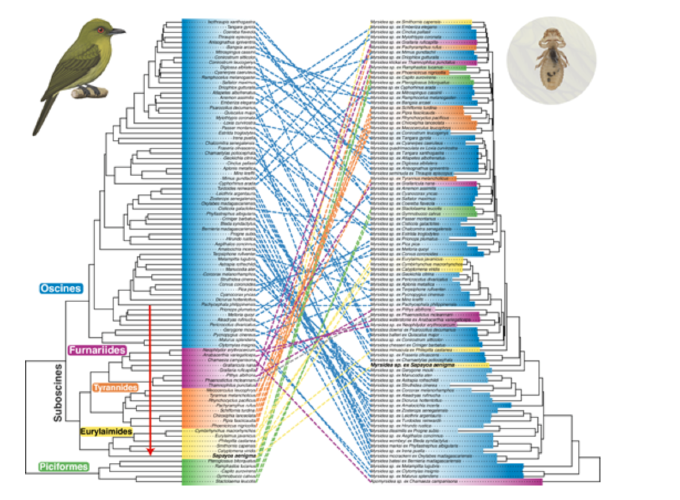
Parasites can provide powerful insights into host evolution and biogeography. The bird Sapayoa aenigma, the only Neotropical member of the otherwise Old World clade Eurylaimides, has long puzzled ornithologists due to its phylogenetic placement and uncertain biogeographic origin. We investigated the evolutionary origin of a chewing louse in the genus Myrsidea found on Sapayoa. Using genome-wide data from 91 Myrsidea specimens from oscine, suboscine and non-passerine hosts, we reconstructed a global phylogeny to evaluate hypotheses about the origin of Sapayoa and its parasite. Phylogenomic, molecular dating and cophylogenetic analyses support a scenario in which the Myrsidea lineage on Sapayoa originated outside the Neotropics and was acquired via host-switching from an Old World oscine. The parasite’s divergence time (24.4–17.9 Ma) postdates the split between Sapayoa and other Eurylaimides, ruling out strict codivergence. Ancestral host reconstruction supports an oscine origin and Old World acquisition, and biogeographic analysis also indicates Old World origins, though with uncertainty in the exact region. These findings support a co-dispersal scenario in which Sapayoa acquired its parasite in the Old World and brought it to the Neotropics. Our study highlights the value of parasites as complementary tools for disentangling complex evolutionary and biogeographic histories. A Spanish translation is available in the electronic supplementary material.